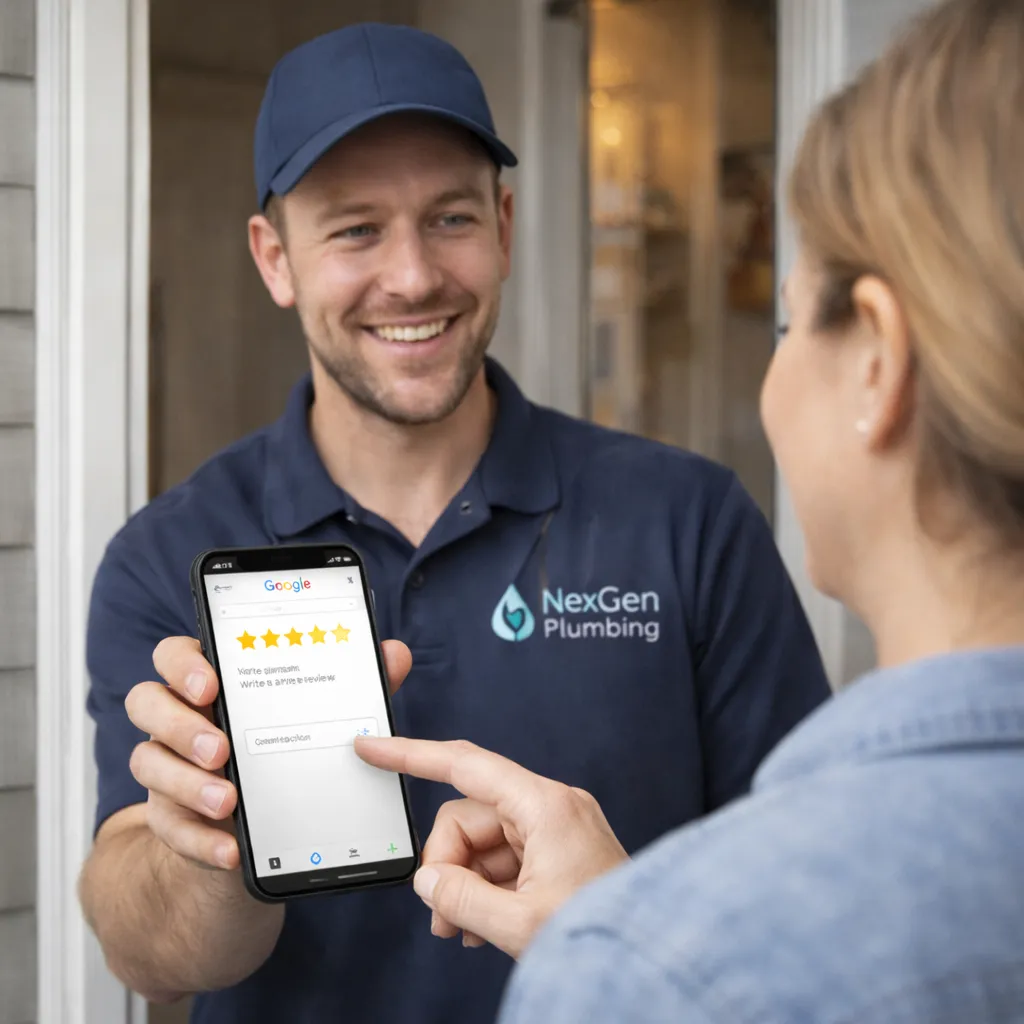
Why Manual Review Collection Fails (And What to Automate Instead)
The Manual Review Dream vs. Reality
Every home service business owner starts the same way: “I’ll just have the team ask for reviews after every job.” It sounds simple. It sounds doable. It even works for about two weeks. Then reality sets in — and the reviews stop coming.
This isn’t a training problem. It’s not a motivation problem. It’s not a “my team doesn’t care” problem. It’s a structural problem: manual review collection is designed to fail at scale, and every single home service business that tries it hits the same walls. Let’s look at exactly why manual systems break down — and why automation has become the only approach that actually works.
Why Your Team Forgets (It’s Not Their Fault)
Technicians in the field are juggling: the job at hand, the next call, traffic, parts, paperwork, payment collection, dispatch notifications, and a dozen small decisions between every job. Asking for a review is a low-urgency task competing with high-urgency tasks all day long.
Human memory simply doesn’t work well in that environment. Studies on task completion show that low-priority actions embedded in busy workflows get skipped 60–80% of the time, no matter how much training or reinforcement you provide. Your techs aren’t lazy. Their brains are triaging correctly — just not in your favor.
Office staff face the same problem. The invoice goes out, the job moves to “complete” in the CRM, and the next three jobs demand attention. By the end of the day, nobody remembers which customers were asked and which weren’t. The system depends on perfect human memory, and perfect human memory doesn’t exist.
Why Sporadic Asks Don’t Move Rankings
Let’s say your team does remember about 20% of the time. You get 2 new reviews this week, 0 next week, 3 the week after. To Google’s algorithm, that pattern looks like a business with erratic activity — which tanks your velocity signal and keeps you stuck in position 5 or 6 in local search.
Remember: Google isn’t grading you on total review count anymore. It’s grading you on consistency. Five reviews per month, every month, outperforms twelve reviews one month and zero the next two. Manual systems can’t produce consistency because humans can’t produce consistency at the pace required. Only systems can.
This is why businesses with manual approaches plateau at 60–80 total reviews while competitors with automated review requests pass 300 in the same time window. The gap isn’t effort. It’s mechanism.
The Tracking Problem
Even when manual systems work occasionally, they create a blind spot: you have no idea what’s working. Did Steve send the text? Did the customer click it? Did they respond to the follow-up? Did they actually leave a review?
Nobody knows, because nobody’s tracking it. So when review flow stalls, there’s no diagnostic information. You can’t see which techs are better at asking, which jobs convert best, which customer types respond fastest, or where the funnel is leaking. You just have a vague sense that “we should get more reviews” — and no data to act on.
Automated systems solve this by default. Every message, every click, every response, every follow-up is logged and measurable. You know exactly what’s happening in your review pipeline and exactly where to optimize. Manual systems are a black box.
The Scale Wall
Manual review collection might limp along when you’re doing 30 jobs a month. It completely falls apart at 100+ jobs a month, and becomes impossible at 300+. The math doesn’t work — no human has time to personally send, track, and follow up on review requests for hundreds of customers each month on top of running the business.
This is why growing home service companies hit a wall around the 50–80 reviews-per-year mark with manual systems. They can’t scale the asking process linearly with job growth, so the review-per-job ratio actually declines as the business expands. More jobs, proportionally fewer reviews, worse local SEO — despite doing more work than ever.
The only way through the scale wall is automation. Systems don’t forget, don’t get busy, don’t prioritize other tasks, and don’t lose steam after two weeks. They execute the same perfect process on the 10th job and the 10,000th job.
The Response Gap
Even if you somehow solve the asking problem manually, responding to reviews is an entirely separate workload — and it’s just as critical for SEO. Google rewards businesses that respond to reviews within 48 hours. Customers judge businesses by how they handle negative feedback.
Manually responding to every review, with thoughtful personalized language, in under 48 hours, across Google, Yelp, Facebook, and other platforms, is a part-time job by itself. Most owners delegate it, then discover the delegate isn’t doing it consistently either, and the whole system collapses.
AI-powered review response automation handles this entirely — generating personalized, context-aware responses to every review within hours, while still flagging negative reviews for owner attention. What used to be a significant time drain becomes a non-issue, handled silently in the background.
What Automation Does That Humans Can’t
Here’s what a properly built review automation system delivers that no manual process can match:
- Triggers the request at the exact optimal moment — not when someone remembers
- Sends via the right channel based on customer preference (SMS/email/voice)
- Follows up automatically at 24 and 72 hours if no review lands
- Stops immediately the moment a review is detected
- Responds to every review with thoughtful AI-generated replies
- Tracks every metric so you know what’s working and what isn’t
- Scales infinitely — works the same on 10 jobs or 10,000
Add video testimonial capture, multi-platform remarketing, and built-in SEO signals, and the gap between manual and automated isn’t a difference of degree. It’s a difference of kind. Manual systems do review collection badly. Automated systems do review collection as a reliable, measurable, scalable function of the business.
The Honest Conclusion
Every home service business owner deserves to have their hard work converted into the reputation that work earned. Manual systems fail that promise. They depend on memory, prioritization, and consistency that simply aren’t available in a busy operational environment.
The businesses winning local search in 2026 all figured this out. They stopped trying to white-knuckle manual review collection and let a system handle it. Their reviews grow steadily. Their rankings climb. Their phones ring. Meanwhile competitors still running manual playbooks wonder why their reviews are stuck in the same place they were last year.
If you want your reviews to compound, stop asking your team to remember — and start letting a system do what a system does best.
Tired of Asking for Reviews and Getting Ignored?
Your AI-powered reputation management system sends review requests via SMS, email, and voice — then follows up until the review is captured. Every customer. Every time. Start dominating local search →
