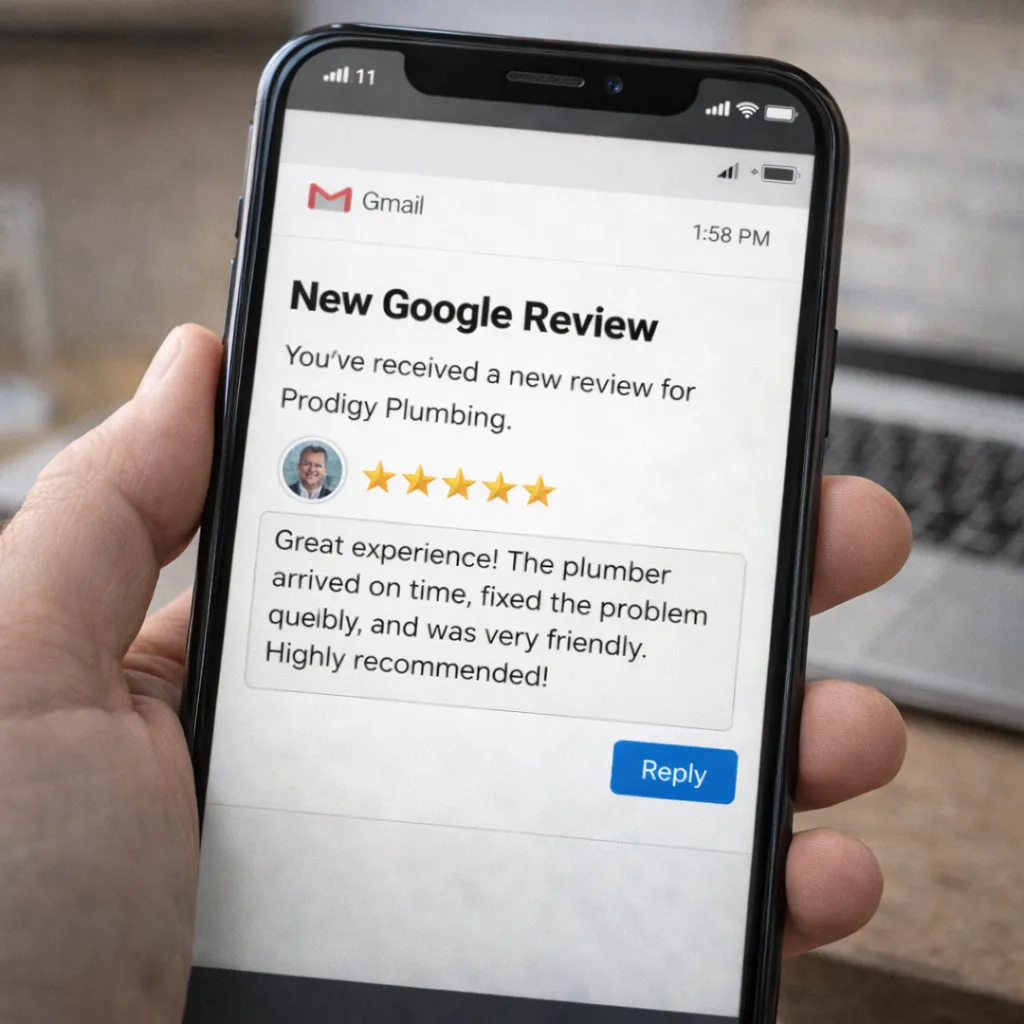
The Psychology of Trust: Why 72% of Customers Won't Call Without Reading Reviews First
What Happens Before a Customer Calls
By the time a new customer dials your number, they’ve already made their decision. The call is just the formality. What most business owners don’t see — and what determines whether the phone rings at all — is the 60 to 180 seconds of research that happens before any action is taken.
That research is almost entirely review-driven. Recent industry data shows over 72% of customers read reviews before contacting a local service business. For higher-ticket jobs like HVAC replacement or major plumbing repair, that number climbs above 85%. The reviews aren’t just influencing the decision — they are the decision.
Understanding what’s happening in the customer’s head during those critical seconds is the key to positioning your business to win the call. Let’s walk through the psychology that drives modern buying behavior in home services.
The Modern Buyer’s Journey in Three Phases
Today’s home service customer moves through a predictable mental sequence before making a call:
Phase 1: Problem Recognition. The water heater stops working. The AC dies in July. A pipe starts leaking. Stress is high, urgency is real, and the customer immediately turns to Google.
Phase 2: Candidate Scanning. They type “plumber near me” or “HVAC repair in [city]” and look at the Map Pack. They scan the three businesses shown: review count, star rating, recency of reviews. In about 8 seconds, they narrow their options to usually two contenders.
Phase 3: Verification. They click into one or both profiles and actually read the reviews. What are other people saying? Are recent customers happy? Did the business respond well to any complaints? Does this feel like a company they’d want in their home?
If you win all three phases, you get the call. If you fail any of them — especially phase three — they move on to the next option. The entire journey takes under three minutes on a mobile phone.
Social Proof in Action
The reason reviews dominate the buyer’s journey is a well-studied psychological principle called social proof. Humans are wired to rely on the judgments of others, especially when making decisions in unfamiliar territory. Hiring a contractor fits that definition perfectly — most people don’t do it often enough to have personal expertise, so they borrow confidence from strangers who went first.
The more strangers who agree (“this plumber is great”), the more confident the next customer becomes. Volume matters because it signals consensus. Recency matters because it signals relevance. Specificity matters because it helps the customer imagine themselves in the same positive outcome.
This is also why fake reviews, even when they slip past Google’s filters, hurt more than they help. Customers have become skilled at detecting inauthentic language. A string of generic 5-star reviews actually lowers trust compared to a mix of detailed, specific, human-sounding reviews — including the occasional honest 4-star.
The 3-Star Danger Zone
Here’s a counterintuitive finding from consumer trust research: businesses with perfect 5.0-star averages are actually trusted less than businesses with averages between 4.5 and 4.8. Why? Because 5.0 looks suspicious. Real businesses get occasional complaints from difficult customers, misunderstandings, and one-off bad experiences. A spotless 5.0 reads as curated or fake.
Conversely, anything below 4.0 stars lands a business in what researchers call the trust dead zone. Customers won’t even explore the profile. The ranking might not even matter — they’ll skip you entirely and go to the competitor showing 4.7.
The optimal range is 4.5 to 4.8 stars with at least 50 recent reviews. That’s the combination that maximizes trust. It says “real business, real customers, occasional imperfection, overall excellent.” Any online review automation system worth using is designed to help you reach and hold that zone.
What Customers Actually Look For in Reviews
When a customer reads reviews, they’re not looking for what most businesses think they’re looking for. They’re not counting stars or tallying numbers. They’re looking for specific signals that answer three unspoken questions:
- Is this business reliable? They scan for mentions of “on time,” “showed up when they said,” “easy to schedule.”
- Are they honest about pricing? They look for “no surprise charges,” “fair price,” “quoted what they charged.”
- Do they actually fix the problem? They want “solved my issue,” “worked perfectly,” “no callbacks needed.”
Reviews that hit all three categories are conversion machines. Reviews that say only “great service” are nearly useless — they don’t answer the questions the customer is actually asking. When you’re training your team on how to ask for reviews, encourage customers to describe what actually happened and how they felt about the resolution.
Trust Signals Beyond the Star Rating
Beyond the review content itself, customers assess several trust signals in a business’s review profile:
- Owner responses signal that the business pays attention and cares about its reputation. Unresponded reviews — especially unresponded negative ones — signal neglect.
- Photo reviews signal authenticity. When a customer takes the time to add a photo, the review reads as more credible.
- Reviewer profiles matter. A review from someone with a full profile and multiple reviews across different businesses carries more weight than a review from a brand-new account.
- Response tone for negative reviews is watched closely. A calm, solutions-oriented response to a complaint can do more for your reputation than a dozen glowing reviews.
Businesses that combine fresh volume, high-but-not-perfect ratings, fast responses, and specific customer language position themselves as the obvious choice. That’s the formula that converts scanners into callers, and callers into jobs.
Turning Psychology Into a System
Trust is earned in microseconds. Once you understand that every element of your review profile is being read as evidence, the game becomes managing the evidence deliberately. You don’t need to manipulate anything — you just need to make sure the best version of your business is the version Google displays.
A good review system handles this automatically: it asks every happy customer to share their experience, it prompts for specific details that become SEO gold, it responds to every review with thoughtfulness, and it keeps the flow fresh so the profile always looks active. That’s how you stop leaving the most important 60 seconds of the customer journey to chance.
More Reviews. More Revenue. Zero Manual Work.
Every review you miss is a customer going to your competitor. Reviews Dominator handles the entire review lifecycle — from request to response to remarketing — so you never lose another opportunity. Schedule a demo today →
