How Google Reviews Directly Impact Your Map Pack Rankings
The Map Pack Is Where Money Gets Made
For any home service business, the Google Map Pack — the three local business listings that appear at the top of a local search result — is the single most valuable piece of digital real estate that exists. It sits above organic search results. It captures mobile clicks before users even scroll. It converts at a rate two to three times higher than any other local search position.
And it’s dominated almost entirely by businesses with strong review profiles.
If you’re serious about dominating local search, you need to understand exactly how Google uses reviews to pick the three businesses that appear in the Map Pack. Once you see the mechanics, the playbook becomes obvious — and the competitive advantage opens up.
What the Map Pack Actually Is
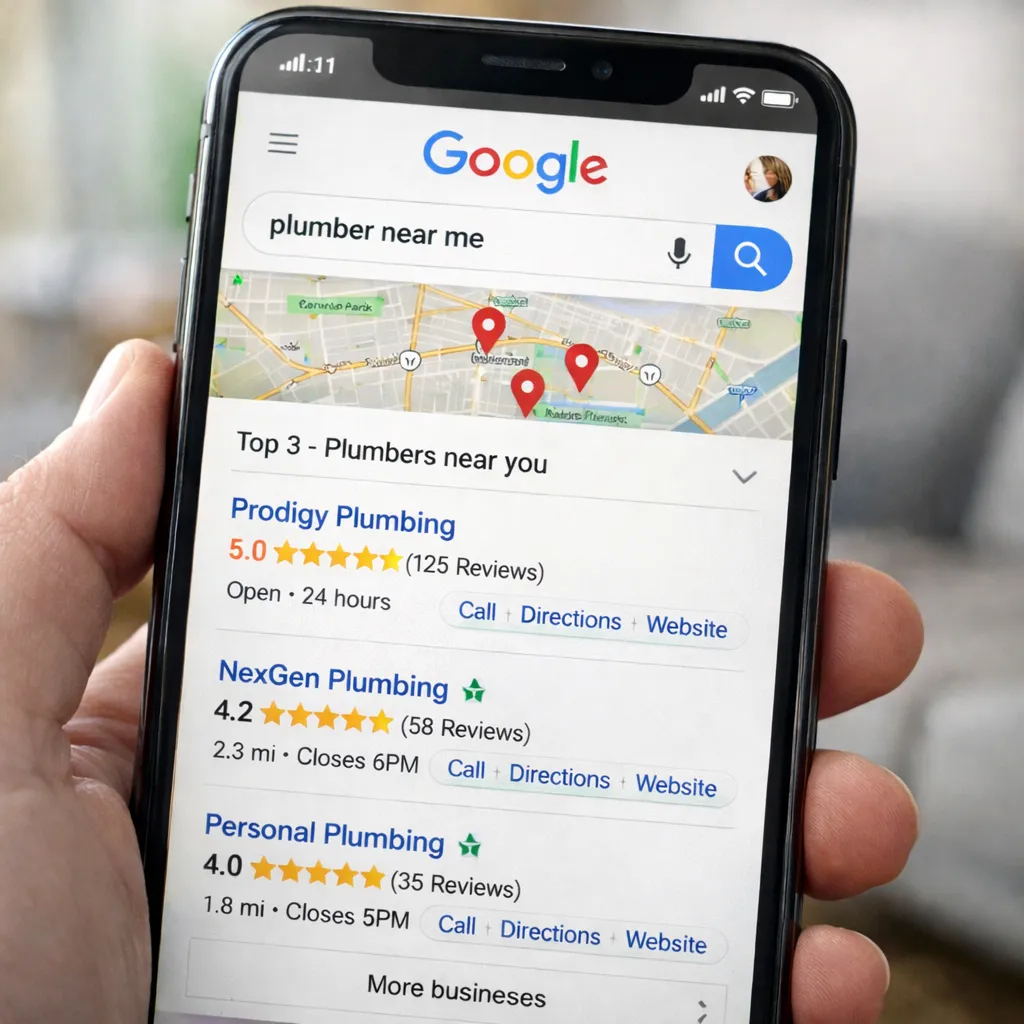
When someone searches for “HVAC repair near me” or “plumber in Oceanside,” Google returns a special section above the normal search results. It shows a map with three pinned businesses, each with a name, rating, review count, address, and phone number. This is the Map Pack, also called the 3-Pack or Local Pack.
The Map Pack is so powerful because of how users behave on mobile. Roughly 88% of local searches happen on a phone, and on a phone screen, the Map Pack fills the entire visible area. Users tap one of the three results without ever scrolling. If your business isn’t one of the three, you effectively don’t exist for that search.
The Three Signals That Determine Map Pack Placement
Google uses three factors to decide which businesses to show in the Map Pack:
- Relevance — How well your business matches the specific search terms and categories
- Distance — How close your business is to the searcher’s location or the location they mention
- Prominence — How trustworthy and well-established Google believes your business to be
Relevance and distance are largely out of your control once you’ve set up your Google Business Profile correctly with the right categories and service area. Prominence is where reviews live — and it’s the factor you can actively influence.
How Reviews Feed Prominence
Prominence is Google’s measure of how important and credible your business appears relative to competitors. Reviews are the primary input, and Google weighs several review attributes differently:
Total review count signals that a lot of real humans have chosen and validated your business. A company with 200 reviews looks more established than one with 20.
Review velocity signals that your business is active and currently serving customers. Ten reviews spread over the last 60 days is a stronger signal than 50 reviews from two years ago.
Review diversity signals authenticity. Reviews from different geographic areas, different job types, and different customer profiles read as organic and trustworthy.
Average rating matters — but not as much as most people think. A 4.4-star business with 180 recent reviews will usually outrank a 4.9-star business with 25 aging reviews. Volume and freshness beat perfection.
Businesses that use Google review management tools to maintain a constant flow of fresh reviews dominate the Map Pack in their markets because they’re hitting all of these signals simultaneously.
Review Keywords and Semantic Relevance
Here’s a subtle signal most business owners miss entirely: the words inside your reviews are being read by Google and used to determine what your business is relevant for. When a customer writes “Joe fixed our water heater leak in Carlsbad on a Sunday,” Google indexes “water heater leak” and “Carlsbad” as semantic signals for your business.
Now when someone in Carlsbad searches “water heater leak repair,” your business becomes a stronger relevance match than competitors whose reviews only say “great service” or “5 stars — would recommend.” Specific, descriptive reviews are SEO gold. Generic, vague reviews are wasted opportunities.
Encouraging customers to mention the specific service and the specific city isn’t manipulation — it’s letting them describe what actually happened. Most will, if asked naturally.
Velocity and Freshness: The Underestimated Factors
The single most underrated factor in Map Pack ranking is review velocity — the pace at which new reviews come in. Google’s algorithm interprets velocity as a proxy for business health. A company receiving 8–15 new reviews per month is clearly operating, clearly serving customers, and clearly worth showing in search results.
A company receiving zero reviews for 90 days signals the opposite. Maybe they closed. Maybe they lost their reputation. Maybe they stopped caring. Whatever the cause, Google deprioritizes stagnant businesses in favor of active ones.
This is why businesses with automated review systems consistently beat businesses that only ask for reviews occasionally. The automation isn’t just about saving time — it’s about maintaining the velocity signal that keeps you in the Map Pack month after month.
Action Steps to Move Up the Map Pack
If you want to climb into the top three local results, focus on these fundamentals:
- Fully complete your Google Business Profile — every field, every service, every photo
- Establish a request system that asks every customer after every completed job
- Aim for 5–15 new reviews per month minimum to maintain strong velocity
- Respond to every review within 24–48 hours, positive or negative
- Monitor your competitors’ review growth and make sure your pace matches or exceeds theirs
None of this is rocket science — it’s discipline and consistency. The businesses dominating the Map Pack aren’t doing anything special. They’ve just built systems that handle reviews automatically while everyone else is still asking manually (or not asking at all).
The Map Pack rewards the businesses that show up every day. Make sure yours is one of them.
Tired of Asking for Reviews and Getting Ignored?
Your AI-powered reputation management system sends review requests via SMS, email, and voice — then follows up until the review is captured. Every customer. Every time. Start dominating local search →
